

Caroline Charpentier Honored with Sloan Research Fellowship
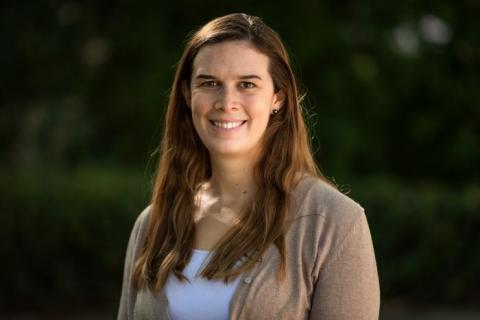
Assistant Professor Caroline Charpentier of the Department of Psychology and UMD’s Brain and Behavior Institute was named as a recipient of the prestigious Sloan Research Fellowship. Charpentier is one of 126 early-career researchers at U.S. and Canadian educational institutions who were recognized for creativity, innovation, and research accomplishments. The recipients are lauded by the Alfred P. Sloan Foundation as “the next generation of leaders.”
Winners receive a two-year, $75,000 fellowship which can be used flexibly to advance the Fellow’s research.
“I am deeply honored and incredibly grateful to receive this award. I am especially appreciative of the Sloan Foundation’s commitment to supporting early-career scientists by investing in the work they are already doing and giving them the resources to take ongoing projects to the next level,” Charpentier said. “This recognition means a great deal to me, because it signals that the lines of research I am developing in my lab are valued not only by my department and UMD colleagues, but also by the broader scientific community. It is very meaningful to see that my work is aligned with the foundation’s mission and its belief that research in STEM fields plays a vital role in building a better world for all.”
With this award, Charpentier joins the ranks of previous winners who have gone on to make stunning contributions to their fields. To date, 59 Fellows have received a Nobel Prize, including John Clarke, last year’s Nobel laureate in physics. More than 70 UMD faculty members have received this globally recognized award.
Charpentier is an interdisciplinary researcher whose work draws from social neuroscience, behavioral economics and computational psychiatry. Charpentier leads the Social Learning and Decisions Lab at UMD, which focuses on uncovering the behavioral and neural computations involved in human social and affective influences on learning and decision-making processes, with a strong interest in how individual variability in these processes and their underlying computations relate to psychopathology.
“My lab seeks to characterize the mechanisms of social learning—how we learn from and about other people. Along with collaborators across multiple UMD departments, we aim to expand our understanding in a way that is more ecologically and clinically meaningful,” Charpentier said.
Charpentier’s training as a cognitive neuroscientist focuses on developing tightly controlled experimental paradigms that allow researchers to isolate and precisely quantify specific cognitive processes.
“While this approach has clear strengths and remains an important part of my work, it has also become increasingly clear that mechanisms identified in such controlled lab settings do not clearly translate to real-world social behavior or mental health outcomes,” Charpentier said. “To address this, my lab is beginning a series of projects aimed at adapting classic social learning paradigms to be more naturalistic and socially relevant. I hope this work will help bridge the gap between experimental precision and real-world applicability.”
Charpentier and her collaborators in the Social Learning and Decisions Lab develop theoretically grounded models of social learning, test them with behavioral and neuroimaging studies, and use data-driven methods to predict mental health symptoms. Ultimately, they hope to build algorithms that capture both the richness of social interaction and the vulnerabilities that lead to psychopathology.
“Caroline’s work, inside and outside of her lab, is innovative and deeply relevant to questions about human interactions, the human brain, and human behavior,” BSOS Dean Susan Rivera said. “She is an incredibly talented researcher, and this recognition from the Sloan Foundation is a testament to the boundless potential of her current and future endeavors.”
In the future, Charpentier hopes to improve our understanding of social learning, and is currently exploring trust learning—a form of social learning that’s particularly relevant in today’s societies: how people learn to trust or distrust others, and how these processes may be disrupted in psychopathology.
“In the longer term, I am particularly interested in developing methods that integrate large-scale, multimodal data—including behavior on cognitive tasks, naturalistic social interactions, video and conversational data, self-reported mental health symptoms, and neuroimaging—to advance computational phenotyping,” Charpentier said. “Ultimately, the aim would be to characterize stable individual profiles that can better capture the complexity and heterogeneity of human social behavior.”
Charpentier’s current and future contributions to the Department of Psychology are highly valued, said Professor and Chair Michael Dougherty.
“When we recruited Dr. Charpentier to UMD a few years ago, we expected her to be an outstanding scholar. She has turned out to be every bit as great as we expected, and much more. This award validates what those of us in the department of psychology already know—that Caroline is a unique talent doing thoughtful, rigorous, and cutting-edge work that will stand the test of time,” Dougherty said. “But more than that, she is an excellent mentor and role model for the many students who have had the good fortune to work with her.”
Published on Wed, 02/18/2026 - 10:48